Segmentation and Tracking
The notebooks below all use spice.segmentation.<method>(). Each method
builds a new SPICEData that shares the input image’s history, and
records what it did automatically.
- notebooks/segmentation/example_unet.ipynb
Trains a U-Net segmentation model (a ResNet-34 encoder, Dice loss) to tell “particle” from “background” in TiO₂ SEM images, using one call:
spice.segmentation.train_unet(). Preparing the dataset, building theDataLoader, setting up the model, training with cosine annealing, and (optionally) checking accuracy on a test set with IoU scoring all happen inside that one call. The returnedSPICEDataholds the per-epoch[train_loss, val_loss]numbers asdata, with the model settings inmetadata.- notebooks/segmentation/example_sam1.ipynb
Segments objects with no training needed at all, using Meta’s Segment Anything Model (SAM v1), via
spice.segmentation.run_sam1(). Shows two ways to use it: (1) automatically finding masks across the whole image (SamAutomaticMaskGenerator,automatic=True), keeping the largest one found; and (2) segmenting from a single point you click (SamPredictor). Both return a newSPICEDatawith the binary mask and a confidence score inmetadata, recorded inspice.history.- notebooks/segmentation/example_sam2.ipynb
The same idea as SAM v1, but with Meta’s newer Segment Anything Model 2 (SAM2), via
spice.segmentation.run_sam2(). One point you click predicts a binary mask on a SEM image. Covers setting up SAM2 (its checkpoint file and YAML config) and running the predictor on the same image and point as the SAM1 notebook, so the two masks can be compared. The returnedSPICEDataholds the mask and confidence score, recorded inspice.history.- notebooks/segmentation/example_nasa_micronet.ipynb
Trains a
UNetPlusPlusmodel (with ase_resnext50_32x4dencoder, pretrained on NASA’s MicroNet microscopy dataset) to segment EBC1 SEM images of an environmental barrier coating (oxide layer vs. background), usingspice.segmentation.run_micronet(). Covers preparing the dataset with Albumentations augmentation, training with early stopping (DiceBCE loss), checking accuracy on a test set (IoU), viewing predictions per image, and saving the first test prediction. Needs thepretrained_microscopy_modelspackage, which isn’t on PyPI and installs straight from GitHub — see Special cases on the installation pages.- notebooks/segmentation/example_trackpy.ipynb
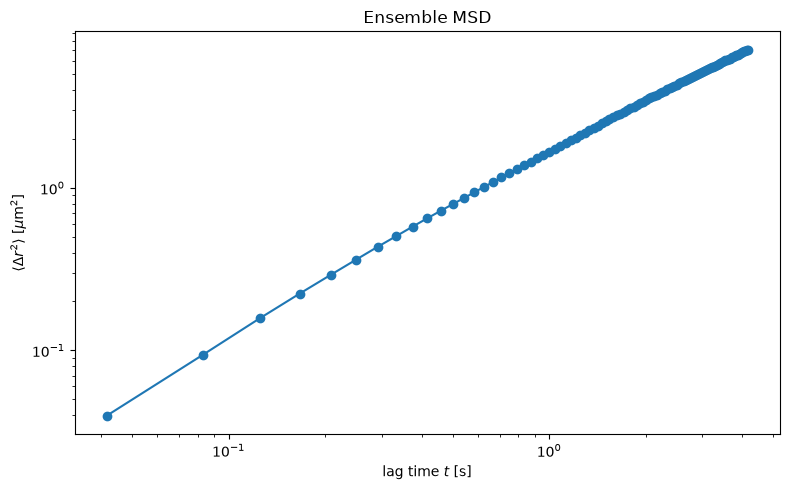
Tracks many particles moving across a sequence of fluorescence microscopy frames, using
spice.segmentation.run_trackpy(). The frame sequence loads as onedataset_type='multiple_frames'SPICEDataviaload_frame_sequence(), and then the whole Trackpy pipeline runs in a single call: finding particles in each frame, linking them into trajectories across frames, dropping short trajectories, optional quality filtering (by mass, size, or roundness), correcting for overall drift, and computing mean-squared displacement (MSD) — both per particle and averaged across all of them. The returnedSPICEDataholds the averaged MSD values asdata, with per-run statistics inmetadata.