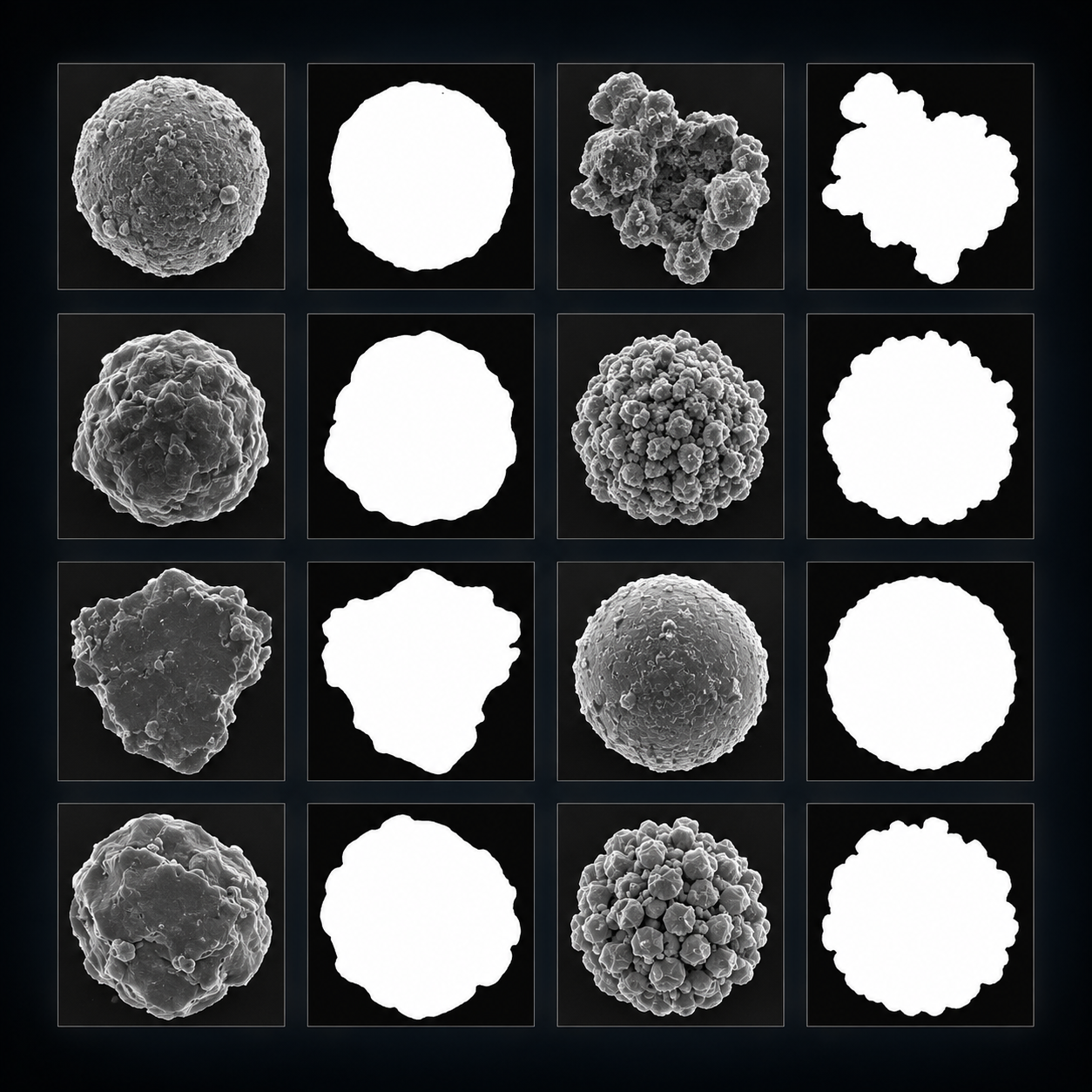
Illustration generated with AI; not experimental data.
Synthetic Data Generation
A fundamental challenge in applying supervised machine learning to scientific microscopy is the scarcity of labeled data. Pixel-level annotation (semantic segmentation masks) of microscopy images requires expert knowledge and is extremely time-consuming. Synthetic data generation offers strategies to produce large annotated datasets efficiently.
Why Synthetic Data?
Training robust segmentation models typically requires hundreds or thousands of annotated images. Several strategies exist to meet this requirement, each with different trade-offs between realism, diversity, computational cost, and annotation effort. Pick a strategy below.
Classical Augmentation
Label-preserving geometric and intensity transforms of existing annotated images.
Physics-Based Synthesis
Composite parameterized particle models onto backgrounds with masks known by construction.
Deep Convolutional GAN (DCGAN)
Train a generator/discriminator pair to learn the distribution of real images.
Stable Diffusion Image-to-Image
Use a pretrained diffusion model to generate realistic, prompt-guided variations.
JuSPICE integration
The juspice.synth_data_module module wraps classical augmentation
and physics-based generation. juspice.dcgan provides the DCGAN
back-end and juspice.stable_diff the Stable Diffusion back-end.
All generated images should be wrapped in SPICEData
and saved via save_data() to keep provenance records.
See Synthetic Data for a module-level explanation and juspice.synth_data_module for full API details.
Synthetic Data Notebooks
The following Jupyter notebooks demonstrate each synthetic data generation strategy:
See Notebook Examples for descriptions of each notebook.
References
Libraries
albumentations — fast, composable augmentation pipeline for images and masks
IOPaint — LaMa-based background-filling tool used by every augmenting generation method (
Aug,PB,PB_NonGauss,SDiff,DCGAN); a separate install, not a JuSPICE dependency (see installation)PyTorch — deep-learning framework underlying the DCGAN and Stable Diffusion generators
Hugging Face Diffusers — Stable Diffusion and other diffusion-model pipelines
See Bibliography for the publications behind the methods on this page.