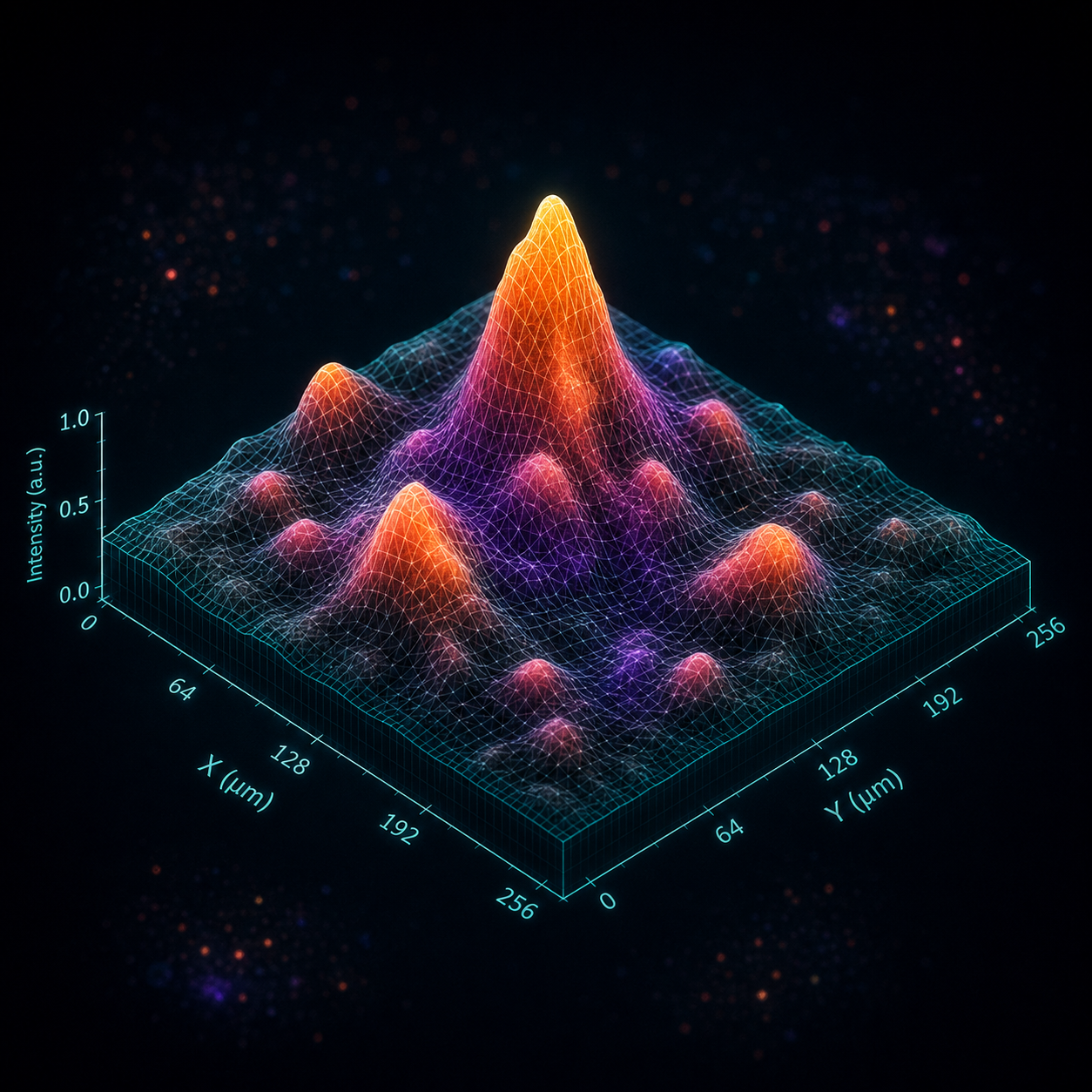
Illustration generated with AI; not experimental data.
Digital Image Processing Basics
This section introduces the fundamental concepts of digital image processing that underpin all the methods used throughout this documentation. For comprehensive treatments, see [6] and the OpenCV documentation [7]. Pick a concept below.
What Is a Digital Image?
Pixels, resolution, bit depth, and color spaces.
Histograms
Intensity distribution, equalization, and CLAHE.
Spatial Filtering
Convolution kernels and smoothing (low-pass) filters.
Edge Detection
Sobel, Prewitt, Laplacian of Gaussian, and Canny.
Image Transformations
Geometric warps and point-wise intensity transforms.
Thresholding and Binarization
Otsu's method and adaptive thresholding.
Morphological Operations
Erosion, dilation, opening, closing, and watershed.
Connected Components
Labelling individual particles or cells after binarization.
Libraries and Tools
This documentation uses the following Python libraries for image processing:
Data I/O and Reproducibility
In this repository, scientific image arrays should be imported with
load_data() rather than with ad hoc readers in notebook
code. The returned SPICEData object keeps the array
together with its source metadata and
DatasetHistory.
Likewise, derived arrays should be written with save_data().
It persists the full SPICEData object as a .npy
file, emits a metadata JSON sidecar, and writes the session-level
Tracker history script — allowing later users to
inspect provenance and re-run the same sequence of operations.
References
Libraries
OpenCV — optimised computer-vision and image-processing library
scikit-image — NumPy-based scientific image processing
Pillow — image I/O and basic transformations
See Bibliography for the publications behind the concepts on this page.